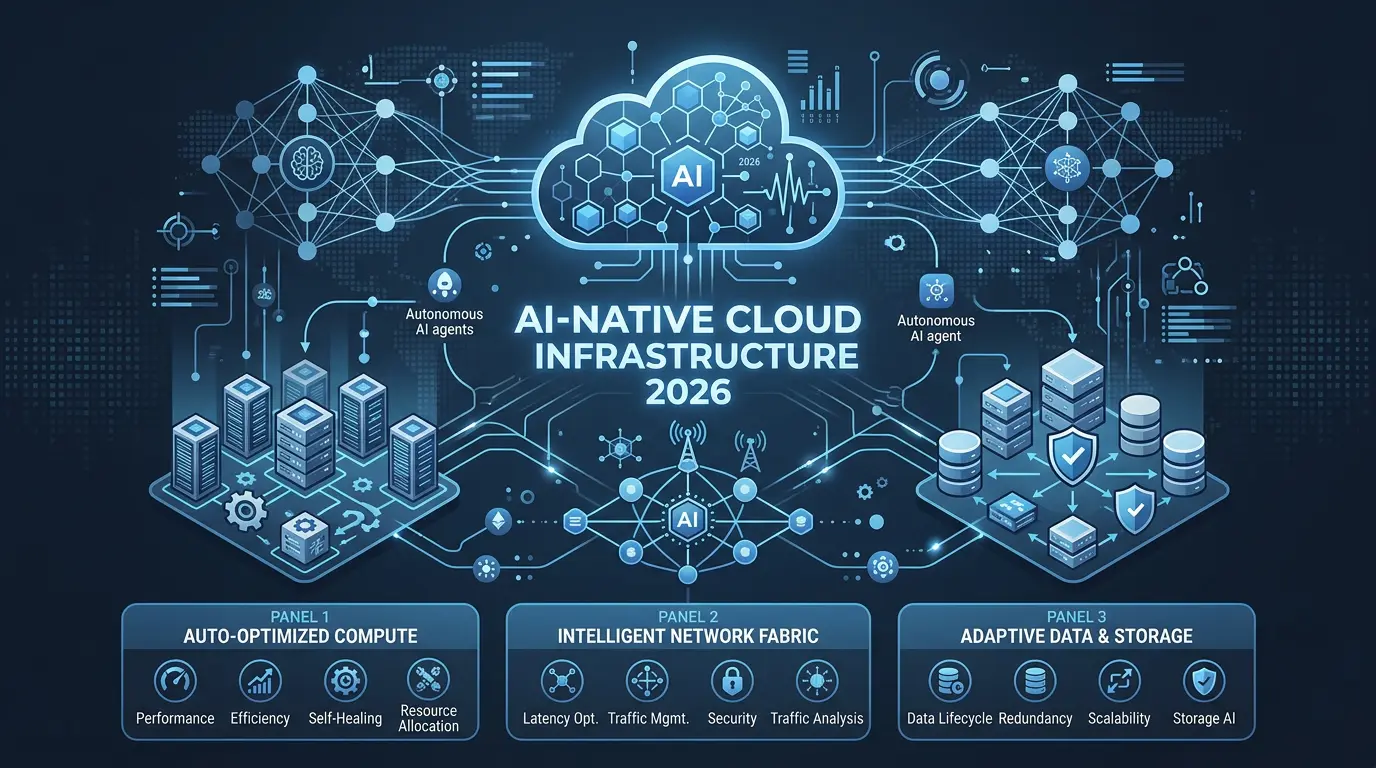
For years, the dominant strategy was to build standard cloud infrastructure and then "layer AI on top." API endpoints, packaged models, data pipelines. In 2026, that approach is dead.
Modern cloud infrastructure doesn't host AI — it is AI. Every layer, from the control plane to the edge runtime, is designed with intelligence baked in. This article breaks down the three pillars of AI-native infrastructure and how to implement them without over-engineering.
1. Multi-Agent Systems as the Control Plane
The deepest shift in 2026 is the adoption of multi-agent systems (MAS) as the native orchestration layer. We're no longer talking about chatbots or assistants. Agents manage infrastructure, optimize costs, and self-heal failures without human intervention.
- Observability agents: Detect anomalies, correlate metrics, and execute automatic rollbacks in seconds, not minutes.
- FinOps agents: Analyze spending patterns in real time, recommend instance changes, and negotiate savings plans against actual workloads.
- Security agents: Identify non-human identities (100:1 vs human according to Gartner) and enforce continuous Zero Trust verification.
2. Strategic FinOps with Automated Governance
Global public cloud spending will exceed $830 billion in 2026 (FinOps Foundation). And nearly 32% is lost to over-provisioning. The era of "cost reporting" is over — FinOps is now a strategic business function.
AI-native FinOps components include:
- Scope 1-3 carbon tracking — sustainability is now an infrastructure KPI, not just PR.
- Proactive optimization agents — detect idle resources before they generate cost, suggest rightsizing and automatic shutdown schedules.
- Unit economics per workload — every inference pipeline, every training run, every serverless function has its own P&L.
Any CTO without visibility into cost per inference is flying blind. Tools like Vantage, CloudHealth, or even AWS Cost Explorer with CUR enabled are the bare minimum.
3. Edge Intelligence and Millisecond Latency
Edge intelligence is no longer experimental. Models trained in the cloud execute on edge devices, reducing latency to milliseconds for critical applications: fraud detection, industrial control, autonomous vehicles.
This requires rethinking architecture:
- Hybrid models: Centralized training (cloud) + distributed inference (edge + cloud depending on latency requirements).
- Specialized silicon: Chips like Graviton4 or Inferentia2 enable efficient inference without massive GPUs.
- Managed cold starts: For serverless functions with models, use warming strategies or maintain a minimum pool of workers with pre-loaded models.
Modular Modernization: Goodbye Big Bang
The Strangler Fig pattern has become the de facto standard for legacy modernization. AI-augmented engineering can analyze tens of thousands of lines of legacy code in under an hour, reducing refactoring time by up to 40% (Gartner).
Modular strategies replace high-risk migrations:
- Extract microservices from the monolith incrementally.
- Use generative AI to produce dependency maps and suggest partitions.
- Keep the legacy system running while building the replacement in parallel.
Conclusion: Infrastructure as Differentiator
Infrastructure is no longer a backend concern — it's the strategic layer where competitiveness is defined. Organizations moving fastest in 2026 aren't just adopting new technologies — they're redesigning how systems, teams, and decision-making interact.
Treating AI, cost governance, and security as separate disciplines is a recipe for failure. AI-native infrastructure unifies them. And the CTOs who lead this integration will set the market's pace.