What Is Platform Engineering (and Why It Matters in 2026)
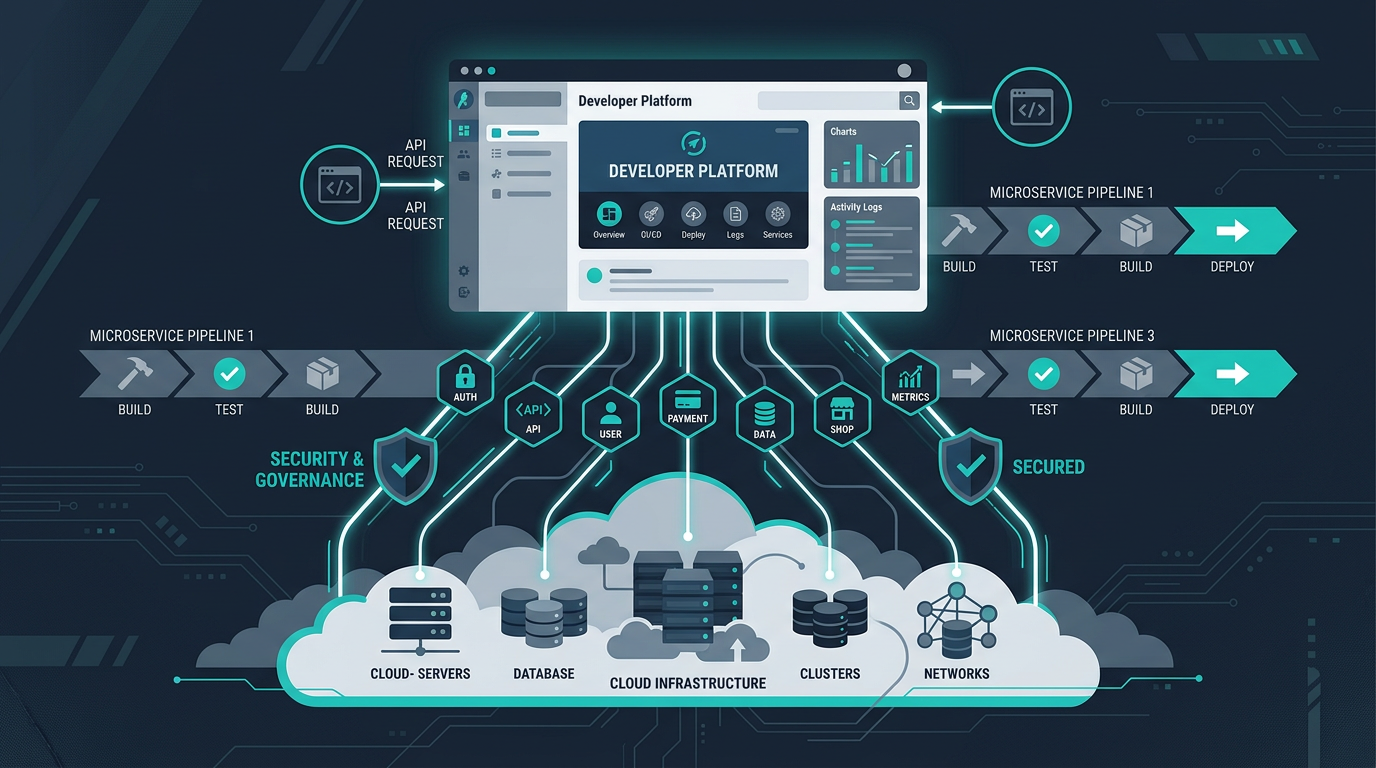
Platform Engineering is the discipline of designing and maintaining an Internal Developer Platform (IDP): an abstraction layer between development teams and the underlying infrastructure. Instead of each squad managing its own Kubernetes clusters, CI/CD pipelines, and security policies, the IDP provides "Golden Paths" — predefined, approved, and automated workflows for the most common scenarios.
By 2026, the concept has matured. According to recent analyses from Google Cloud and the FinOps Foundation community, organizations that adopt IDPs report 30-40% reductions in new service onboarding time and a significant decrease in incidents related to manual infrastructure configuration.
Golden Paths: The Heart of an IDP
Golden Paths are standardized workflows that cover everything from scaffolding a new microservice to deploying it in production with monitoring enabled. A well-designed IDP should offer:
- Automated scaffolding: Generate repositories with structure, tests, Dockerfile, and CI/CD pipeline in seconds.
- Policy-as-code deployment: Validate compliance (HIPAA, SOC2, GDPR) before each release with zero manual intervention.
- Built-in observability: Metrics, logs, and traces pre-wired into every new service.
- Cost attribution: Automatic resource tagging for FinOps and per-team chargeback.
- Secrets and access: Automatic credential rotation, no .env files in repositories.
Backstage: The De Facto Standard
Spotify Backstage has become the reference platform for building IDPs. As a CNCF project (incubated since 2022), Backstage offers a service catalog, technical documentation plugin, software health scorecards, and software templates. Its plugin-based architecture allows extension to any cloud provider, CI/CD system, or monitoring tool.
Alternatives like Port, Humanitec, and Kratix have also gained traction, but Backstage maintains the advantage of being open-source, allowing full customization without vendor lock-in.
IDP + AI: The New Frontier
Integrating AI assistants within the IDP is the most disruptive trend of 2026. "Infrastructure Assistants" let developers describe in natural language what they need ("a serverless service with PostgreSQL in us-east-1, alerting when p99 exceeds 200ms"), and the platform generates scaffolding, configures resources, and deploys the corresponding infrastructure.
However — and this is critical — AI must operate within the boundaries defined by policy-as-code. Governance doesn't disappear; it becomes invisible. The platform team defines the rules; the AI executes them.
Common IDP Pitfalls
- Starting with the tool, not the problem: Installing Backstage without mapping your team's actual workflows creates an empty platform nobody uses.
- Early over-engineering: An IDP doesn't need to support 50 scenarios on day one. Start with 2-3 Golden Paths and expand on demand.
- Ignoring developer experience: If the platform is slower or more complex than doing it "by hand," teams will bypass it. The IDP must be the easiest path, not the most bureaucratic.
- Lack of ownership: An IDP without a dedicated platform engineering team becomes a repository of abandoned templates.
The Success Metric: Lead Time for Change
The simplest and most powerful metric for measuring an IDP is lead time for change (LTC): how long it takes from a developer committing a change to it reaching production. An effective IDP should reduce this from days to hours for standard changes. If your LTC doesn't improve after implementing an IDP, something is wrong with the design.
The next step is correlating LTC with change failure rate (CFR) and cost per deploy. When all three indicators improve simultaneously, the IDP is fulfilling its purpose.
Conclusion
Platform Engineering is not another cloud ecosystem fad. It addresses a real need: scaling software engineering without proportionally scaling the infrastructure team. A well-designed IDP reduces cognitive load, standardizes best practices, and frees developers to focus on what matters: the product.
If your organization has more than three teams working in cloud-native, you are likely already paying the cost of operational friction. The question isn't whether you need an IDP — it's when you will start building one.