Why this matters right now
There's a quiet migration happening that most analysts are missing. After a decade of "move everything to the cloud," a growing number of engineering teams are pulling AI inference workloads back on-prem.
The triggers: GPU cloud costs that are 3–5× what compute-equivalent CPU workloads cost per hour. Data sovereignty requirements tightening across LATAM and Europe. And a maturing ecosystem of open-source models that run respectably on consumer-grade hardware — no $50K GPU clusters required.
On Hacker News, the debate about "are we repeating the telecoms crash with AI datacenters?" has over 400 points. The fear isn't that AI is a bubble. It's that we're building centralized AI infrastructure the same way we built centralized cloud infrastructure — and the rebalancing will hit just as hard.
1. The Unit Economics of Cloud AI Are Shifting
When GPT-4-class models cost $0.03 per 1K tokens, the math favored the cloud. In 2026, with fine-tuned open-source models (Llama 4, Mistral Large, Qwen 3) running at $0.003 per 1K tokens on local hardware, the equation flips — especially at scale.
For a company processing 10 million inference requests per month:
- Cloud API route: $3,000–$10,000/month in token costs + GPU compute
- On-prem route: $500–$1,500/month in electricity + hardware amortization + ops overhead
The crossover point varies, but for any team doing more than 500K inference calls/month, the on-prem argument deserves a real spreadsheet. Not a gut feeling.
2. Data Sovereignty Is the Silent Driver
This matters more for LATAM than most US-based CTOs realize. Ecuador, Brazil, and Mexico are tightening data localization requirements around AI. If your models touch personal data, financial records, or health information, routing inference through US-based cloud GPUs creates regulatory exposure.
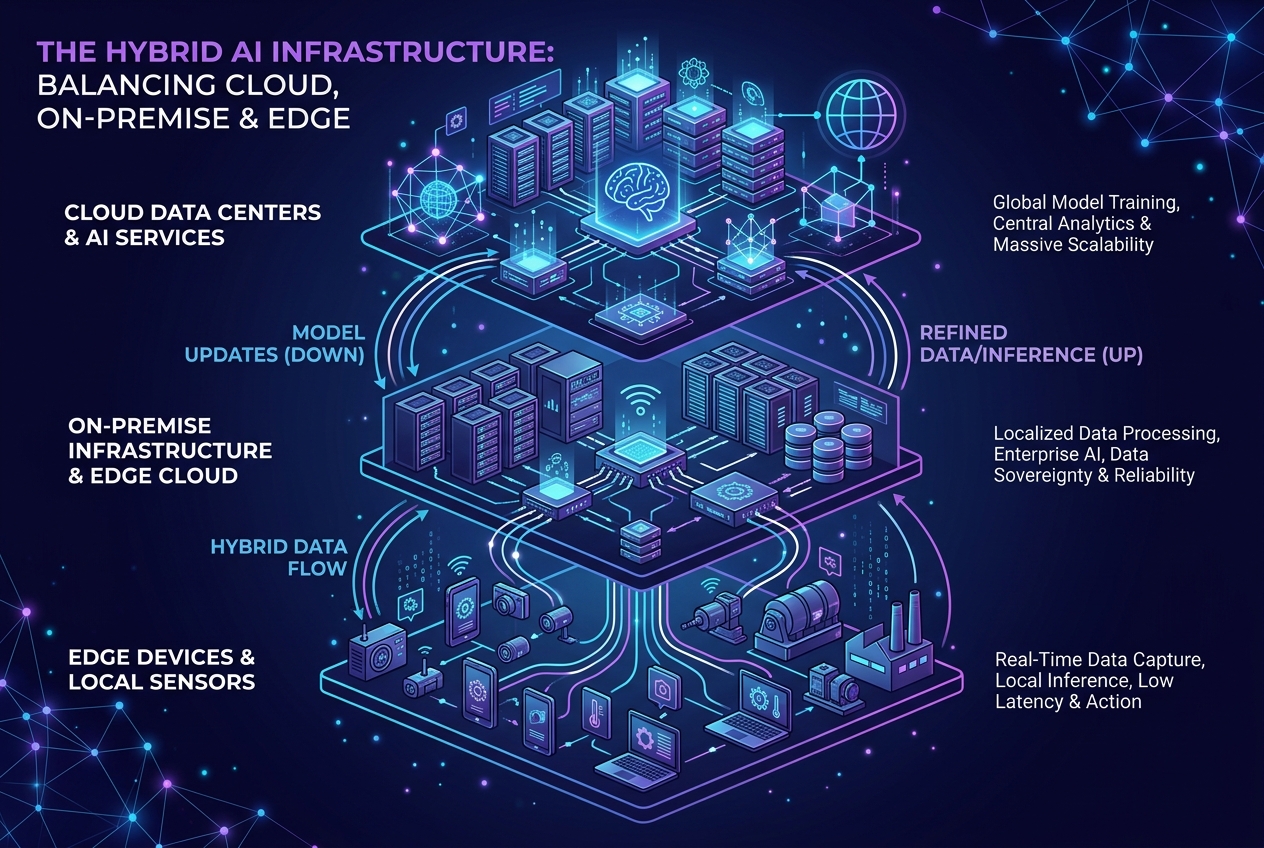
The workaround is elegant: deploy inference on local infrastructure (on-prem or OCI's LATAM regions), keep training in the cloud. This hybrid model gives you the best of both worlds — cloud elasticity for training, local sovereignty for inference.
3. Edge Inference Changes the Architecture Game
Running models at the edge (Cloudflare Workers, local IoT gateways, branch office servers) isn't about saving money. It's about latency and resilience.
A fraud detection model that needs sub-100ms response can't route to a centralized GPU cluster. A manufacturing quality check that runs on a factory floor can't depend on a cloud API that might be down.
The architectural shift I'm seeing: tiered inference layers.
- Tier 1 (Edge): Small models (< 7B params) for real-time, latency-sensitive decisions
- Tier 2 (On-prem): Medium models (7–30B) for batch processing and data-sensitive workloads
- Tier 3 (Cloud): Frontier models (70B+) for complex reasoning, RAG, and training
This isn't just cost optimization — it's architectural resilience. And it maps directly to the stateless, decoupled patterns that mature engineering teams already use.
The Bottom Line
The cloud was never the destination. It was a rental. For AI workloads, the rental model is showing its limits. CTOs who design for hybrid inference — edge + on-prem + cloud — will have cost advantages, regulatory safety, and architectural freedom that cloud-only teams can't match.
The companies that win the next phase of AI won't be the ones with the biggest cloud bills. They'll be the ones with the most flexible infrastructure strategies.
I design multi-tier AI infrastructure for companies running hybrid cloud/on-prem workloads. If you're tired of your GPU bill doubling every quarter, let's talk.