In 2026, AI infrastructure spending is growing faster than any other IT category. Gartner projects global data center spend will surpass $650 billion this year, and Forrester reports that AI-optimized servers account for 25% of hardware spending growth. But the problem isn't how much you spend — it's how you spend it.
One of the most expensive mistakes engineering teams make is mixing experimentation workloads with production workloads on the same infrastructure. Both environments have radically different requirements in cost, performance, availability, and governance. Treating them equally is a recipe for unpredictable bills and fragile deployments.
Why Experimentation Is Different
Experimentation workflows — model training, fine-tuning, RAG evaluations, prompt testing — share characteristics that make them inefficient for production infrastructure:
- Intermittent GPU usage: Data scientists train in bursts. An H100 GPU can run at 100% for hours and then sit idle all weekend. On a production cluster, that sunk cost hurts.
- Massive checkpoints: Experiments generate model snapshots that take tens of GB. Without lifecycle policies, storage costs balloon.
- Ephemeral environments: Experimentation notebooks and containers should be disposable. If they persist, they accumulate technical debt and inconsistent configurations.
- No strict SLAs: An experiment failing at 3 AM is acceptable. An inference endpoint responding slowly at 3 AM is an incident.
The Cost of Mixing Environments
When you share infrastructure between experimentation and production, the following happens:
- Training jobs compete for GPUs with live inference, causing latency degradation.
- Cost allocation tags get mixed: you can't tell if the spending spike was an experiment or real traffic.
- CI/CD pipelines can be affected by poorly planned resource cleanup.
- MLOps teams can't apply different auto-scaling policies for each workload type.
Environment:Experiment and Environment:Production. On GCP, use labels. This enables precise cost filtering in your billing dashboard.
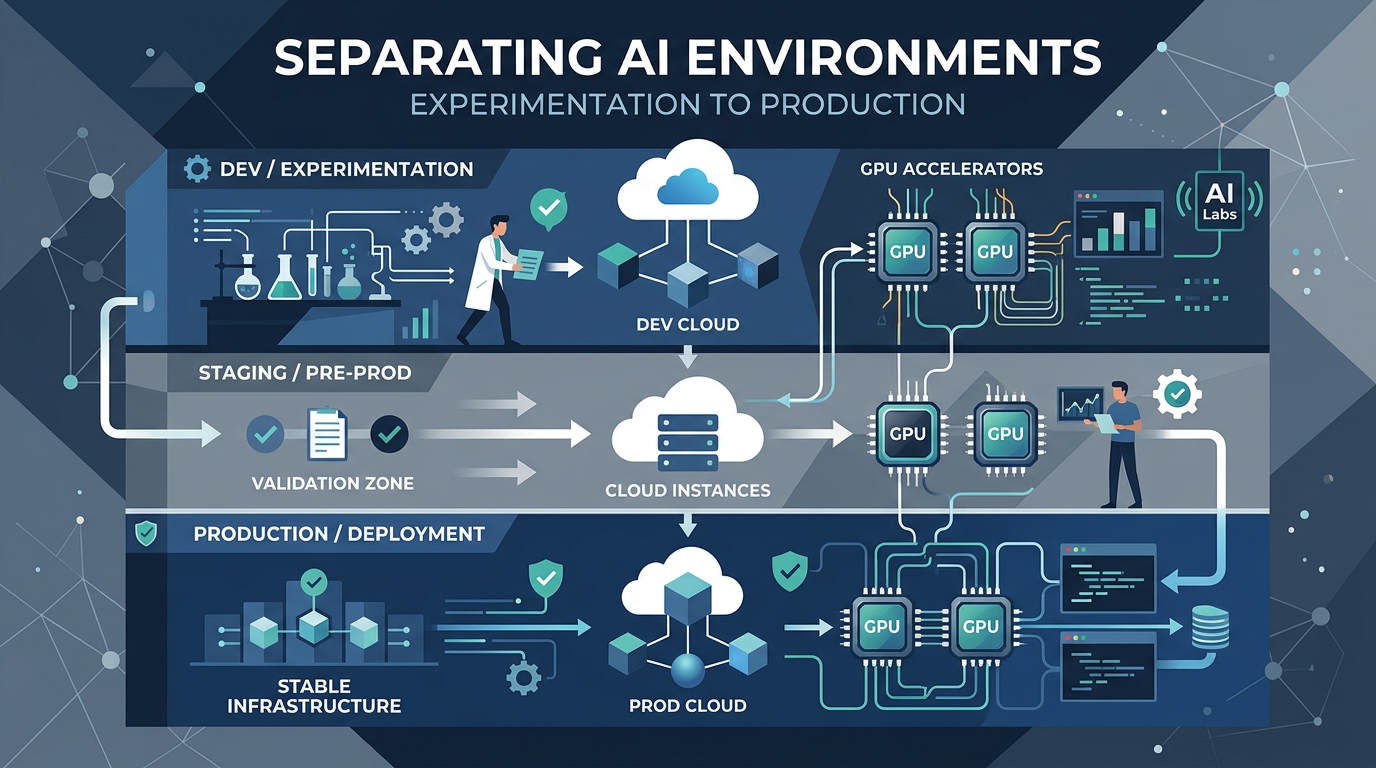
Recommended Architecture: Three Layers
The strategy that works best in teams that have already scaled AI in production is to split infrastructure into three well-defined layers:
Layer 1: Experimentation (Sandbox)
- Spot or preemptible GPUs. Up to 70% savings vs on-demand instances.
- Ephemeral storage volumes. No automatic backup.
- Daily spending limits configured per team/project.
- Auto-shutdown after N hours of idle time.
- No public internet exposure.
Layer 2: Pre-production (Staging)
- Partially reserved GPUs (1-2 dedicated instances per team).
- Synthetic datasets or representative samples, not full production data.
- Performance metrics (latency, throughput) logged but without critical alerts.
- Bias and fairness evaluation of models.
Layer 3: Production
- Reserved or dedicated GPUs with capacity guarantees (compute reservations).
- Auto-scaling based on real latency metrics, not just CPU/memory.
- Automatic backups, multi-zone failover, contractual SLAs.
- Shadow mode / canary deployments for new models.
- Granular cost allocation per customer or feature.
Cost Optimization Strategies by Layer
Each layer has its own FinOps logic:
| Layer | FinOps Strategy | Potential Savings |
|---|---|---|
| Experimentation | Spot + auto-shutdown + daily limits | 60-70% |
| Pre-production | Partial reservations + reduced datasets | 30-50% |
| Production | Reserved instances + auto-scaling + caching | 20-40% |
Practical Tools to Implement Separation
- Kubernetes + Node Pools: Use separate nodepools with taints and tolerations for experimentation vs production. Spot GPUs go to a nodepool with taint
experiment=true:NoSchedule. - Kubeflow / MLflow: Orchestrate experimentation pipelines with metric tracking. Define artifacts as non-replicable outside the sandbox environment.
- Budget alerts: Configure budget alerts per project in each cloud provider. For experimentation, use hard limits (they cut spending). For production, use soft limits (notify only).
- Automated idle detection: Use scripts that detect idle GPUs for more than 2 hours and terminate them automatically. On Kubernetes,
cluster-autoscalerhelps if nodes are correctly tainted. - Storage lifecycle policies: Model checkpoints > 7 days in experimentation move to cold object storage (S3 Glacier, GCP Archive). Checkpoints > 30 days get deleted.
Lessons Learned in Production
I've seen teams implement this separation with concrete results:
- A SaaS team reduced their GPU bill by 45% by moving experimentation to spot instances with overnight auto-shutdown.
- A bank eliminated 80% of their false latency alerts by isolating training workloads from the inference endpoint.
- A healthtech startup reduced model deployment time from 3 days to 4 hours by standardizing pipelines per layer.
Implement separation from the initial design. Migrating later is more expensive than building it right from the start.