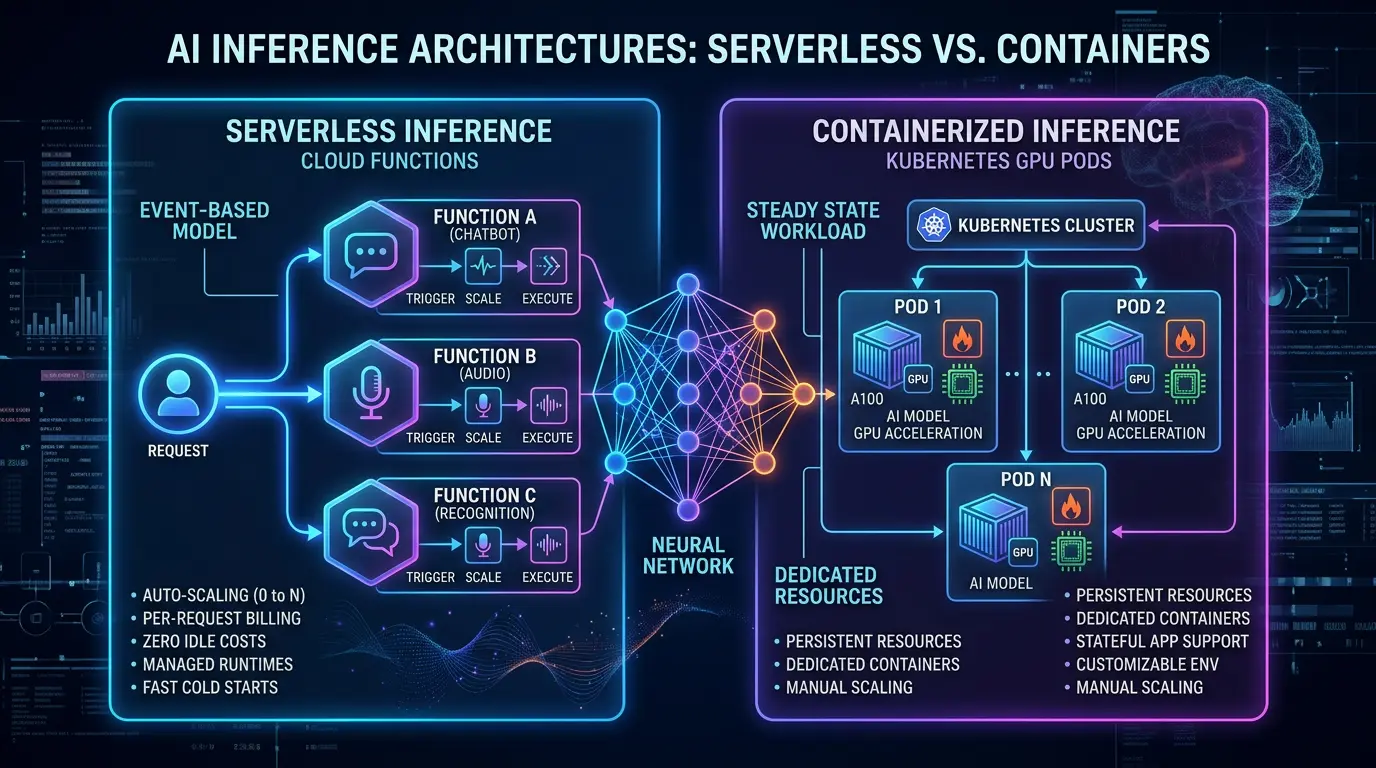
Your AI app isn't "just another web service." It has spiky inference traffic, strict latency SLOs, and background pipelines that can become your biggest cost center without you noticing. That's why the serverless vs containers decision shows up earlier than most teams expect — right after the demo goes viral or the first enterprise customer asks about compliance, uptime, and data residency.
Pick the wrong runtime and you'll feel it in week two: p95 latency creeping up, surprise bills, throttling during bursts, or a DevOps workload your team can't sustain. Choose the right one and you get predictable performance, controllable costs, and a path from MVP to production without rewriting everything.
Based on analyzing over a dozen production inference deployments in 2026, this article presents a practical decision framework with tangible indicators: time per request, concurrency, GPU requirements, model size, and your team's operational maturity.
The 2026 Context: It's Not an Ideological War
People still talk past each other because "serverless" can mean FaaS, managed platforms, or simply "I don't want to manage servers." And "containers" can mean Docker on a VM or a full Kubernetes stack with service mesh, autoscaling, and policy enforcement.
The CNCF Annual Cloud Native Survey 2026 found that 82% of container users run Kubernetes in production. The survey describes Kubernetes as a common operating layer for modern systems and AI workloads. But for a CTO, the real decision isn't "which runtime is better" — it's "which runtime fits this specific AI workload".
Because the same AI product may include: real-time inference, batch ingestion, embedding pipelines, retraining jobs, queues, vector search, and GPU-backed services. Each one deserves a different runtime.
Decision Framework: 5 Critical Variables
1. Traffic Profile
If your inference receives burst traffic (hundreds of requests in minutes, then silence), serverless gives you the best marginal cost. You pay per invocation, not for idle capacity. If your traffic is steady and predictable, containers with reserved capacity give you better cost-to-performance ratio.
- Unpredictable bursts → Serverless (Lambda, Cloud Run, RunPod Serverless)
- Steady 24/7 load → Containers (EKS, GKE, OKE, horizontal autoscaling)
- Mixed → Hybrid: serverless for spiky inference, containers for batch pipelines
2. Cold Start Tolerance
This is the most overlooked factor. For large language models (70B+ parameters), cold starts on self-managed serverless average 15-30 seconds of initial latency. If your SLO demands sub-500ms responses, cold starts will kill you.
Specialized platforms like RunPod have reduced cold starts to sub-200ms with FlashBoot, but this applies to pre-loaded containerized models. For most generic FaaS, if your p95 can't tolerate cold starts, lean toward containers.
- Critical latency (under 300ms p95) → Containers with warm capacity reservation
- Flexible latency (>2s) → Serverless works fine
- Small models (<7B) → Serverless with keep-warm is acceptable
3. GPU Requirements
This is where traditional serverless stumbles. Most FaaS (AWS Lambda, Cloud Functions) doesn't support native GPUs. Platforms like RunPod Serverless, Modal, or Beam offer GPU-backed serverless inference, but with limitations: supported models, VRAM memory, and available regions.
If you need specific GPUs (A100, H100, L40S) or multi-GPU configurations, containers on Kubernetes with GPU node pools are the proven path. The GPU-as-a-Service market reached $7.34 billion in 2026, growing 28.7% annually — and most of that spend is on containers.
- GPU serverless available → RunPod, Modal, Beam, DigitalOcean Inference
- Specific/multi-GPU → Kubernetes + GPU node pools (GKE, EKS, OKE)
- CPU-only inference → Any runtime works
4. Operational Costs and Team Load
Serverless reduces operational load — no servers to manage, no kernel patching, no cluster scaling. But it introduces hidden costs we've explored in previous articles: NAT Gateway, excessive logging, network egress, and the ~15-20% "serverless tax" on base compute cost.
Containers, especially Kubernetes, require a team with SRE skills — or at least someone who can debug a CrashLoopBackOff at 2 AM. If your team is small (<5 engineers) with no dedicated DevOps, serverless significantly reduces operational risk.
- Small team, no SRE → Serverless first (Cloud Run, Lambda + API Gateway)
- Medium team with DevOps → Managed containers (EKS, GKE Autopilot)
- Large team, mature SRE → Custom Kubernetes with optimized GPU scheduling
5. Portability and Vendor Lock-in
Serverless FaaS (Lambda, Cloud Functions) ties you to an ecosystem. Migrating from AWS Lambda to Google Cloud Functions isn't trivial — each platform has its own event model, permissions, and runtime. Containers, properly packaged with Docker + Kubernetes manifests, are portable across any cloud or on-premise.
For teams that value infrastructure sovereignty and the option of multi-cloud rebalancing (a recurring theme on this blog), containers offer more strategic flexibility.
The Hybrid Strategy: Best of Both Worlds
In practice, most mature teams end up with a hybrid architecture: serverless for the glue (webhooks, queues, schedulers, lightweight preprocessing) and containers for heavy inference or model serving.
Concrete example: a real-time recommendation system can run serverless in the first months while you validate traffic patterns. When you hit 10K requests/minute, migrate the model to a containerized GPU deployment on Kubernetes. The feedback webhooks and retraining queues stay serverless.
Quick Decision Matrix
Use this matrix as a starting point for your next architecture decision:
• p95 latency under 300ms, no cold start tolerance → Containers first
• Unpredictable traffic, pay-per-use preferred → Serverless first
• Specific GPUs or multi-GPU → Containers (Kubernetes)
• Small models, flexible latency → Serverless
• Multi-cloud portability → Containers
• Small team, critical time-to-market → Serverless MVP, containers later
TL;DR — What to Remember
- No universal runtime — Choose by workload, not by trend
- Serverless is great for early spikes but cold starts kill strict latency SLOs
- Containers with GPU are the production standard for serious inference
- Hybrid is the norm in mature teams: serverless for glue, containers for heavy lifting
- Fastest path: serverless MVP → understand unit economics → migrate hot paths to containers
Deciding the architecture for your next inference workload? The answer isn't in a runtime — it's in your traffic data, latency requirements, and team composition. Measure first, choose after.